
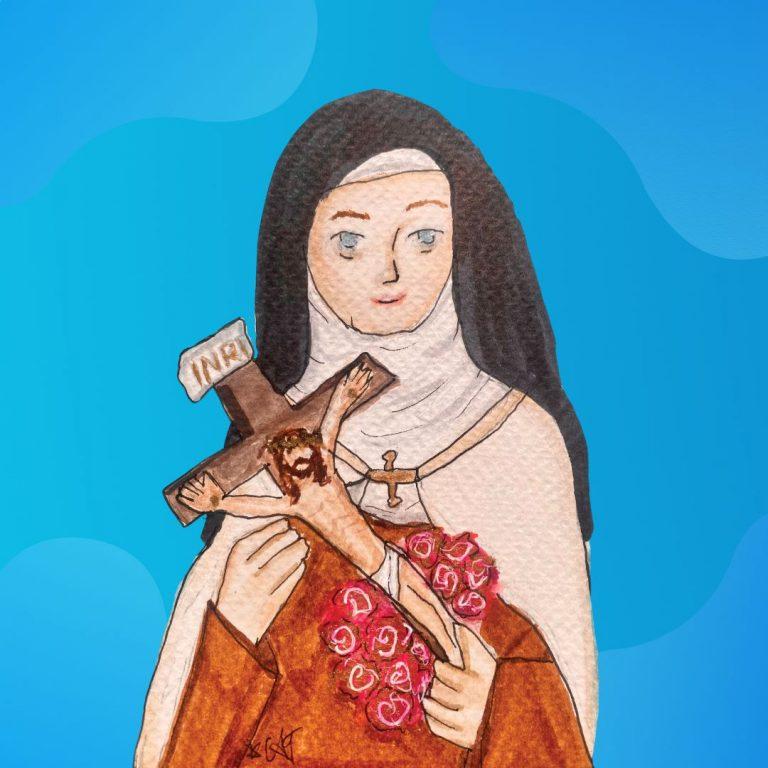
St. Thérèse of Lisieux (pronounced tuh-REHZ of Leez yeu) was a French Carmelite nun who lived a short, hidden life. She is most famous for writing a diary that teaches us how to love God and our neighbor in our day to day lives. Thérèse was declared a Doctor of the Church in 1997. She is only one of four women in the Catholic Church to be given this title. St. Thérèse teaches us that Jesus does not demand great actions from us, but rather He requests that we simply surrender ourselves to the divine will with love and gratitude.
St. Thérèse shows us that holiness is within the reach of anyone who lives to do God’s will with love in every little moment of his or her life. Her writings reveal to us how she surrenders herself into God’s providence in all the little moments of her life.
Thérèse called this simple, childlike path her “Little Way.” It is a spirituality of imperfection. She says, “Jesus deigned to show me the road that leads to this Divine Furnace and this road is the surrender of the little child who sleeps without fear in its Father’s arms.” In a letter to a priest, Thérèse writes: “Perfection seems simple to me; I see it is sufficient to recognize one’s nothingness and to abandon oneself as a child into God’s arms.” Any Christian “perfection” is, in fact, our ability to include, forgive, and accept our imperfection.
The Childhood of Saint Thérèse of Lisieux
Thérèse Martin was born January 2, 1873, in Alencon, France. Her parents, Louis and Zelie Martin, were a very holy couple – both of them had discerned religious life prior to meeting each other. Their blessed marriage produced nine children – five of whom survived to adulthood. Thérèse Martin’s home had a deep devotion to the Blessed Mother. Her father was given a statue of the Immaculate Conception as a young man, and Thérèse’s mother consecrated all nine of her babies to the Virgin Mary.
Tragedy for Little Thérèse
When she was four years old, St. Thérèse’s mother died from breast cancer. At this time, her father and older sisters cared for her. They doted on her and provided for all her needs. This was the saddest time of her life. She became overly sensitive and cried easily.
Little Thérèse Suffers a Long Mysterious Illness
Thérèse’s sister Pauline was her main caregiver until she was nine. But in 1881 Pauline entered the Carmelite convent at Lisieux. St. Thérèse became unconsolably upset, so much so that she came down with an illness that doctors were sure she would never be cured from. She seemed to be almost constantly in delirium, which perplexed the doctors who treated her.
During moments when the pain was less severe, she loved to weave garlands of flowers for the Blessed Mother. “We were then in the beautiful month of May, when all of nature was adorned with the flowers of springtime; only the little flower was languishing and seemed destined to die. That is until she received sunlight from above, and that sunlight was the miraculous statue of the Queen of Heaven.”
Throughout her illness, St. Thérèse gazed upon the statue of Our Lady and asked Our Lady to cure her. Thérèse’s father asked for Masses to be said at Notre Dame Cathedral to cure Thérèse. At the same time a novena was begun to the Blessed Virgin. Thérèse became steadily worse during this time until she could not even recognize those who stood beside her. Finally, on the Sunday before the novena ended, Thérèse had a spasm of delirious pain while her sisters were praying.
A Miracle Happens
Thérèse recalls turning toward the Immaculate Heart of Mary and “begging her with all my heart to have pity on me. All of a sudden the statue became alive! The Virgin became beautiful, so beautiful that I could never find words to express it…But what penetrated to the roots of my being was her ravishing smile. At that moment all my pains vanished.”
Her Vocation as a Nun
St. Thérèse had desired to be a nun from the time she was three. It became a certainty at the age of fourteen and she was convinced that it was time to enter the convent. It was difficult for father to give up all of his daughters to the convent, but he knew St. Thérèse’s vocation, and he supported her decision. Her age was not an issue for the nuns. She had to convince her uncle, however, as well as the bishop, that she was mature enough to enter into religious life.
Religious life was exactly as St. Thérèse had expected and she transitioned easily into her vocation. She did discover rather quickly that religious life comes with certain difficulties, especially in how different personalities of the nuns can cause problems. The Prioress was a capable administrator, but had a terrible temper along with a variety of other vices that caused many problems in the Priory. St. Thérèse learned to accept the ill treatment she received from Mother Marie out of genuine love for her and obedience.
Dad Becomes Ill
During this time, Thérèse’s father became ill. He suffered multiple strokes and became unstable. He could no longer live on his own and was placed in a mental institution for his own safety. This weighed heavily on Thérèse. In lucid moments he informed his doctor that this humiliation was necessary since he had never experienced one. He visited Thérèse in a wheelchair shortly before he died. As he left that visit he told his daughter that he would see her again in heaven. He died in 1894. Their reunion would not be postponed for too long.
Near the end of her life, Thérèse explained the Little Way to her sister, and it became part of her autobiography, The Story of a Soul. In contrast to the “Big Way” of heroic perfectionism, she says, in essence, “I know when I am a little one, I almost draw God’s love toward me. God has to love me and help me because I can’t do anything by myself. So I bring to God not my perfection, but my imperfection.” Then with utter confidence, she says, “I know God comes rushing toward me.”
St. Thérèse of Lisieux, pray for us!
Sacred Heart of Jesus, have mercy on us!
Immaculate Heart of Mary, pray for us!