
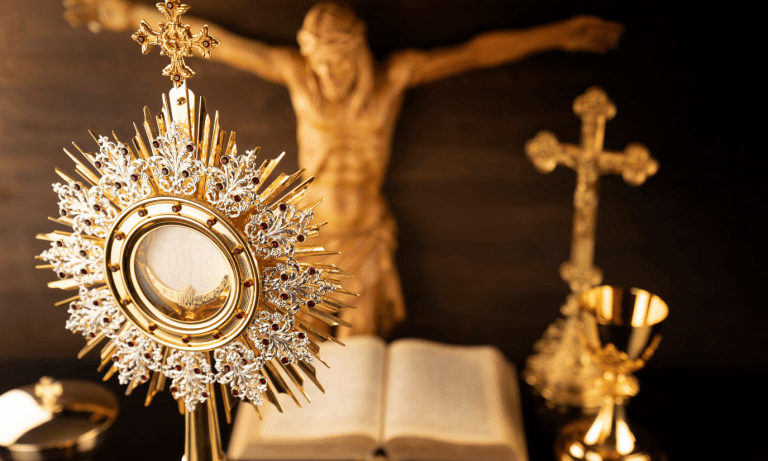
Have you ever wondered what happens during Eucharistic adoration? Many people have heard about this form of worship but they don’t really understand it. We worship Jesus in Eucharistic adoration because we know that Jesus is really present to us in a real and substantial way in the Eucharist.
Why We Worship Jesus in the Blessed Sacrament
The Church teaches us that Jesus is truly present, Body, Blood, Soul, and Divinity, in the Holy Eucharist. We know this because Jesus taught us in the Gospel that His Body will sanctify us and give us life: In the Book of John, chapter 6, verses 48 through 57 Jesus says: “I am the bread of life. Your ancestors ate the manna in the desert, but they died; this is the bread that comes down from heaven so that one may eat it and not die. I am the living bread that came down from heaven; whoever eats this bread will live forever; and the bread that I will give is my flesh for the life of the world.” The Jews quarreled among themselves, saying, “How can this man give us [his] flesh to eat?” Jesus said to them, “Amen, amen, I say to you, unless you eat the flesh of the Son of Man and drink his blood, you do not have life within you. Whoever eats my flesh and drinks my blood has eternal life, and I will raise him on the last day. For my flesh is true food, and my blood is true drink. Whoever eats my flesh and drinks my blood remains in me and I in him. Just as the living Father sent me and I have life because of the Father, so also the one who feeds on me will have life because of me.”Our Catechism teaches us that, “”At the Last Supper, on the night he was betrayed, our Savior instituted the Eucharistic sacrifice of his Body and Blood. This he did in order to perpetuate the sacrifice of the cross throughout the ages until he should come again, and so to entrust to his beloved Spouse, the Church, a memorial of his death and resurrection: a sacrament of love, a sign of unity, a bond of charity, a Paschal banquet ‘in which Christ is consumed, the mind is filled with grace, and a pledge of future glory is given to us'” (CCC 1323).
The Last Supper and the Institution of the Eucharist
On Holy Thursday we remember the Last Supper. On the night He was betrayed, Jesus gathered all his disciples together for the Last Supper. This was the night He instituted the Last Supper and the Church also teaches that on this night He also started the priesthood! These disciples were his closest friends on Earth. They spent 3 years with Jesus, learning all about the Kingdom of God from Him. Jesus taught His disciples, the Church’s very first priests, how to remember Him always though partaking of His Body and Blood in the Eucharist.How the Bread and Wine become the Eucharist at Mass
We are able to receive Jesus through the priest who consecrates the bread and wine at Mass. The priest acts in the person of Christ at the moment of consecration. Listen in the Mass for the moment when he says, “This is My Body” and then “This is My Blood.” When the priest says these words he is acting in the person of Christ. This is called In Persona Christi! It is an amazing gift to be called to the priesthood and to give us Jesus in the Eucharist. Even though the bread looks like bread, and the wine tastes like wine, when the priest consecrates it in the Mass it becomes Jesus. It is a Divine Mystery and a beautiful gift. We should always receive Jesus with great reverence and deep love.What Happens During Holy Communion at Mass?
During Holy Communion at Mass you consume Jesus in the Blessed Sacrament. Do you know what is happening at this moment? The Church teaches that Jesus will physically remain within you for about 10 to 15 minutes. This is why you ought to really give all of your attention to Jesus immediately after receiving Holy Communion. During these precious minutes the Body, Blood, Soul and Divinity of Jesus is physically inside your body and you are a physical tabernacle for our Lord. At this time you ought to pray to Him in an intimate way and really give your heart to Him in gratitude. Receive with love and gratitude. Jesus comes to us in a hidden way. We must receive Him with humble, contrite, and grateful hearts filled with adoration. The Church says that when your body has digested the Eucharist, after about 10 to 15 minutes, the physical presence of the Lord is no longer present:Our catechism teaches us that, “The Eucharistic presence of Christ begins at the moment of the consecration and endures as long as the Eucharistic species subsist” (CCC 1377).